Eyes past print
Modeling fluent reading. Introduction of outside text every period of every day in every class. The opportunity to bring relevance to adolescents. With whole-school immersion in text and reading, ideas and concepts naturally follow. The teacher reads, the student follow along a copy of the text. Content-area literacy expert, Janet Allen calls it “eyes past print with voice support.” At my school, we call it a requirement… one element of a building-wide literacy plan.
Two years ago, after our sit-down session with Janet Allen in Orlando, Florida, our leadership team decided on a school-wide implementation of this strategy as an element of our focus on literacy skills. Co-Principal in charge of instruction, Dr. Jeanette Westfall, was a former elementary teacher, high school communication arts teacher and instructional coach. There is no doubt that her background helped her decide that a non-negotiable approach to reading improvement across content areas was a valuable thing given our situation.

Why we went there
Data analysis in our school improvement planning sessions clearly indicated the need for a systemic effort to improve reading. However, witnessing and characterizing the problem is only the beginning. The ability to design concrete, strategic approaches to solving such a problem is a crucial next step. Bringing the teeth of accountability into the picture is the final piece of the puzzle in comprehensively addressing a systemic educational issue.
The accountability piece tied to EPP is a direct requirement from our building administration to employ this “read aloud” strategy for an absolute minimum of five minutes per class per day. For students this translates to a daily minimum of twenty minutes of engagement with rigorous text with a fluent reader. The next logical step of a strategic teacher is to quickly adjust planning to take advantage of this requirement to bring rigorous and relevant content-specific text into the beginning (or end) of each period.
For a teacher with traditional style, this also forces at least one transition within the daily lesson. In the hands of an effective teacher, these transitions help to keep kids actively engaged and using their brains in varied ways. Data showed that not only was there a need, but that our kids simply weren’t reading enough. You can make strong suggestions about what goes on outside of the classroom. Inside the four walls of a classroom is a different story. You can guarantee immersion within the walls of a school building.

Lit2Go
In other posts this year, I have suggested online services that might add to our implementation of EPP. In this post, I would like to introduce another interesting online resource from Florida’s Educational Technology Clearinghouse. Lit2Go is a website I remember running across a year or so ago on Apple’s iTunes. On the USF site within iTunes you will find audio files for K-12 education organized by grade level.
However, in my opinion, the organizational website for Lit2Go is what makes it useful for the strategy described above as well as others. The main page allows many typical content searches for literature. Author, Title, Keyword, and Reading Level are all available search functions as well as a direct link to the files on the iTunes service for slipping smoothly into your iPod.

My first try was an author search– I pretty randomly chose Lewis Carroll. I ran down the list of ten offerings for the author and clicked to select The Two Clocks. The contents page for any selection has a nice set of overview information such as an abstract, word count, reading level, origin, genre, lexile level, theme, suggested educational strategy, Sunshine State Standards (of more use if you are actually IN Florida), and more. On this page, it is the collection of not only the .mp3 audio file of the work, but also the text in both .html and .pdf format that makes this a valuable resource. It also looks as if some pieces contain other “support material,” though the attached document for this particular story seems pretty useless.
Overall, the fact that this site provides both audio and clearly-printed text of a good number of classic pieces makes it valuable for efficiently selecting and managing EPP within a literature or communication arts class.
An easy win
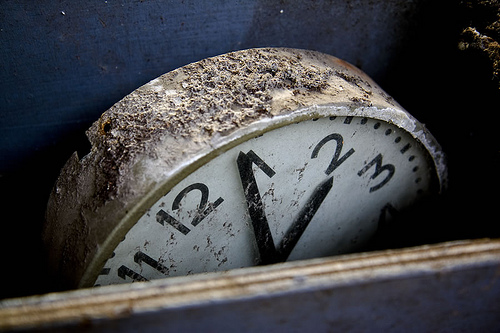
The “clock that doesn’t go” in Lewis Carroll’s story is right two times per day. The other clock which loses a minute a day is only right twice per year. Surely, implementing EPP in a setting where reading immersion strategies are warranted is a way to be “right” at least four times per day. If this form of “being right” seems worthwhile to you in your own educational setting, then give Lit2Go a try and come back and tell us what you thought. Did it work quickly and easily for the described strategy? Even better… do you have another innovative use of Lit2Go to share? Bring it here, and help us all to be right more than two times per day.
What I have found particularly true in the past year is that even the fanciest website on the Internet doesn’t produce a solid educational event outside of the carefully-created framework of a skilled instructor. Compared to many of the applications/websites I have talked about on this blog in the past year, this one could be seen as one of the less “sophisticated.” However, any good teacher knows that what happens when you plug a device into the wall… pales in comparison to what happens inside the mind of a child.
Artwork thanks:
*Iqra: Read by Swamibu on Flickr*On the platform, reading by moriza on Flickr
*Le temps s’est arrêté by tany_kely on Flickr .
